Research
Reasoning and agentic intelligence
Investigating planning, tool use, memory, and coordination in systems that act over extended workflows.
In brief
What makes a sequence of model decisions reliable?
- Connect planning to environment feedback, explicit state, and bounded tools.
- Keep remembered assertions, verified evidence, and authorized actions distinct.
- Evaluate complete trajectories, including interruptions and recovery, rather than final answers alone.
From an answer to a sequence of decisions
An agentic system works through a changing environment. It interprets an objective, chooses actions, receives feedback, and updates its state. Success depends on the sequence as a whole. A correct first answer offers little reassurance if a later tool call uses stale information or a retry creates a duplicate transaction.
NYIC’s research in reasoning and agentic intelligence examines this relationship between deliberation and action. We study planning, tool selection, memory, coordination, and evaluation over extended tasks. The program asks how models can use feedback productively while operating within explicit authority and resource boundaries.
The scientific questions are connected to production architecture. A model needs enough freedom to solve unfamiliar problems, while the surrounding system needs predictable control over external effects. We treat this as a joint design problem involving learned policies, typed interfaces, state machines, and accountable review.
Deliberation and environmental feedback
Reasoning in an interactive system includes deciding what to inspect next. An agent may need another document, a calculation, or a tool result before it can choose a useful action. The information acquired can change the plan. This gives evaluation a richer target than the correctness of a single final response.
ReAct explored interleaving language-model reasoning with actions and observations. It is an influential example of connecting deliberation to environmental feedback. Its specific results belong to its evaluated tasks. Enterprise agents additionally require durable state, authorization, and explicit treatment of failures that affect external systems. Read the ReAct paper.
A useful research distinction is between a plan and a commitment. A plan describes intended future work under assumptions. A commitment changes the external world or consumes a scarce resource. The system should be able to revise plans freely while subjecting commitments to the appropriate checks. Keeping these concepts distinct makes recovery and human review easier to reason about.
Planning under partial information
Many workflows begin with an underspecified request. The agent must infer which information is missing and decide whether to ask, investigate, or proceed under a bounded assumption. A good plan includes dependencies and stopping conditions. It also identifies where uncertainty can be resolved by observation.
We investigate plans as structured objects. A step can record its purpose, required inputs, expected evidence, allowed actions, and completion conditions. This structure supports validation before execution and comparison after execution. It also prevents a persuasive narrative from masking an impossible dependency or an unauthorized action.
Long-horizon tasks require replanning. A missing document may invalidate several later steps. A tool response may reveal that an account no longer exists. The research challenge is to revise the affected portion of the plan while retaining valid work and preserving a clear account of what changed. Repeating the entire workflow can waste resources and create inconsistent results.
Tool use as a learned and constrained capability
Tool use involves several decisions. The agent selects an operation, constructs arguments, interprets its response, and decides what to do next. Toolformer studied learning when and how to invoke APIs as part of language modeling. It motivates research into tool selection and result incorporation, while operational authority remains a separate system responsibility. Read the Toolformer paper.
A typed tool schema helps validate argument structure. It cannot establish that the selected account is correct or that the user authorized the action. These questions require context and policy. The surrounding execution layer should resolve identities, enforce scope, validate preconditions, and record the outcome.
Training examples should include refusal to act when prerequisites are missing. They should also include safe retries, ambiguous responses, partial completion, and recovery after an interruption. Otherwise the learned behavior may be optimized for idealized demonstrations that omit the conditions most likely to cause production incidents.
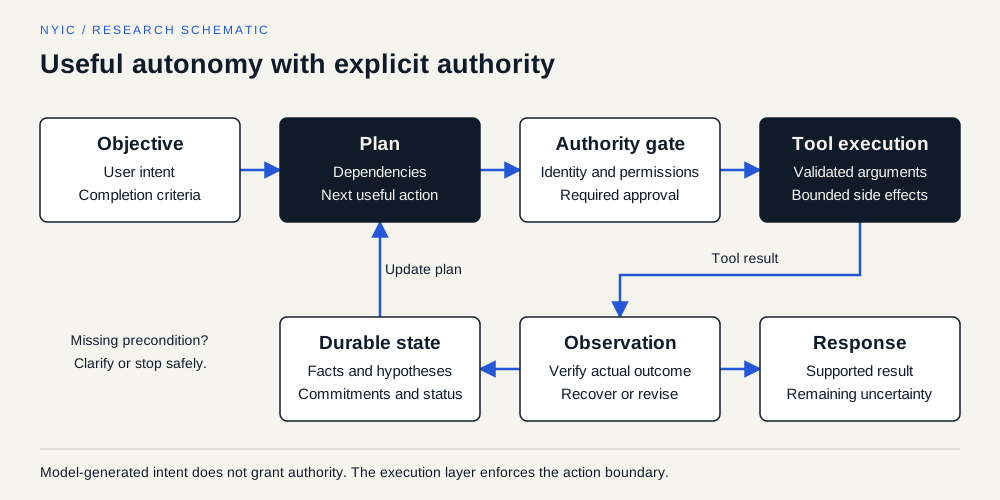
Open the conceptual diagram at full size
Conceptual NYIC diagram. Tool observations update the plan while an independent authority gate controls external actions.
A worked investigation workflow
Consider an illustrative agent helping an operations analyst investigate a payment exception. It can search internal records, compare transaction details, and prepare a recommendation. Releasing a payment requires a separate authorized decision. The agent’s useful autonomy lies in evidence gathering and structured analysis within that boundary.
| Stage | Agent responsibility | System responsibility |
|---|---|---|
| Clarify | Identify the transaction and requested outcome | Confirm user identity and access scope |
| Investigate | Select relevant records and comparisons | Enforce record-level permissions |
| Analyze | Explain discrepancies and unresolved questions | Validate calculations and source versions |
| Recommend | Propose a next step with supporting evidence | Require the designated review where applicable |
| Recover | Reconcile uncertain tool outcomes | Prevent duplicate effects and retain audit state |
Suppose a lookup times out after the service completed its operation. A naive retry can be harmless for a read and dangerous for a write. The workflow should therefore classify operations by effect and support idempotency or reconciliation where needed. This is an architecture requirement that evaluation should exercise through injected failures.
The final recommendation should contain verified facts, inferences, missing information, and the proposed action. A reviewer should be able to inspect the relevant evidence without reconstructing the entire conversation. This reduces the gap between an impressive demonstration and a system that people can operate repeatedly.
Memory with explicit status
Agent memory can hold user preferences, verified facts, task state, intermediate hypotheses, and prior tool results. These categories have different lifetimes and authority. Treating every remembered statement as equally reliable invites error. A hypothesis should remain a hypothesis until evidence changes its status.
We examine memory representations that preserve source, timestamp, confidence basis, and scope. A fact about one customer should not silently become a general rule. A temporary access grant should expire. A tool result from an earlier workflow may require refresh before it supports a new action.
Compression introduces another challenge. Long-running tasks may need summaries to fit a model’s context. Evaluation should test whether those summaries retain exceptions, unresolved questions, and commitments. Comparing summary similarity with the original text is insufficient. The relevant test is whether subsequent decisions remain correct after the original context is removed.
Coordination between agents
Multiple agents can separate expertise or parallelize independent work. They can also duplicate effort, propagate unsupported claims, and obscure responsibility. Coordination research should therefore identify the benefit a second agent provides and compare it with a simpler single-agent or deterministic workflow.
A useful coordination protocol specifies ownership, shared state, handoff criteria, and conflict resolution. An agent receiving a finding should receive its evidence and uncertainty. Agreement between agents does not provide independent confirmation when all agents relied on the same flawed source or repeated the same model judgment.
Resource accounting matters. Parallel agents can increase latency efficiency while increasing total compute. A workflow that produces a slightly better answer at several times the cost may be appropriate for a rare high-value task and unsuitable for a high-volume service. Evaluations should report both quality and resource use.
Measuring long-horizon reliability
We measure agents at the level of outcomes and transitions. Outcome measures include task completion, evidence quality, unauthorized actions, and user correction. Transition measures include tool selection, argument validity, state consistency, recovery behavior, and adherence to approval boundaries.
Failure injection is especially valuable. Tests can introduce unavailable services, malformed responses, revoked permissions, conflicting documents, and interrupted execution. The expected behavior should be defined before the run. In some cases the correct outcome is a safe stop with a clear explanation and a recoverable record.
Evaluation should also inspect termination. Agents can continue investigating after they have enough evidence, stop before a critical check, or become trapped in repeated low-value actions. Explicit budgets and completion conditions provide useful controls and measurable research targets.
Enterprise implications
Agentic intelligence can help institutions carry complex work across systems. Its value depends on dependable boundaries around authority, evidence, memory, and recovery. These boundaries are part of the system’s capability. They allow useful autonomy to expand without making operational behavior opaque.
NYIC connects agent research to production engineering through reproducible scenarios and observable state transitions. The objective is an agent that can make progress, recognize uncertainty, recover from ordinary failures, and give people a clear basis for review. That combination creates a practical foundation for more capable systems over time.